
 All Courses
Are you planning on taking the GMAT? Are you unsure of the GMAT score validity? Do not fret, we will guide you through the GMAT scores, their validity, what a good GMAT score is and so on. Before we begin, let us take a look at the GMAT exam and what it entails.
About the GMAT
The Graduate Management Admission Test (GMAT) is conducted by the Graduate Management Admission Council (GMAC) for those who wish to pursue a management degree in India or abroad. The GMAT is a globally recognised examination that is available to you all through the year.
If you are planning on taking the GMAT, you should check if you are eligible or not. Once you are eligible to take the GMAT, you can register for it online through the official GMAT website. The registration process is rather simple and won’t take you more than 15 minutes. After the GMAT registration process has been completed, you have to make a payment for the exam. The GMAT fee payment is $250, which is approximately 18,300 INR. The plan of action after you’ve registered for the GMAT is to begin preparing for it. However, the preparation process requires you to be familiar with GMAT sections, the scoring scheme of each of the sections, and the GMAT syllabus. So let us take a quick look at the GMAT sections and the GMAT scoring scheme.
GMAT Sections
The GMAT consists of four sections— Verbal Reasoning, Quantitative Reasoning, Integrated Reasoning and Analytical Writing Assessment. The GMAT exam sections test your knowledge in simple math and if you possess critical analysis, critical thinking, reading, writing, interpretation, data analysis, and problem-solving skills.
GMAT Scoring Scheme
Before we dive into the GMAT score validity, let us take a closer look at the scoring scheme of the GMAT. The scores for each section of the exam are as follows:
| Section | No. of Questions | Duration | Scores |
| Verbal Reasoning | 36 | 65 minutes | 6 to 51, increases by a one-point increment |
| Quantitative Reasoning | 31 | 62 minutes | 6 to 51, increases by a one-point increment |
| Integrated Reasoning | 12 | 30 minutes | 1 to 8, increases by a one-point increment |
| Analytical Writing Assessment | 1 | 30 minutes | 0 to 6, increases by a half-point increment |
| Total GMAT Score | – | 3 hours 8 minutes (including breaks) | 200 to 800, increases by a ten-point increment |
The total GMAT score is an aggregate of the GMAT Verbal Reasoning and Quantitative Reasoning scores. It is important to understand that your GMAT score is a direct result of how well you do in the Verbal Reasoning and Quantitative Reasoning sections. On the other hand, the Integrated Reasoning and Analytical Writing Assessment sections are scored separately and do not contribute to your total GMAT score. While these sections do not actively contribute to the total GMAT score like the Verbal Reasoning and Quantitative Reasoning sections do, they may have a bearing on the overall score. Hence, you need to prepare well and do well in each of the GMAT sections.
For How Long is the GMAT Score Valid?
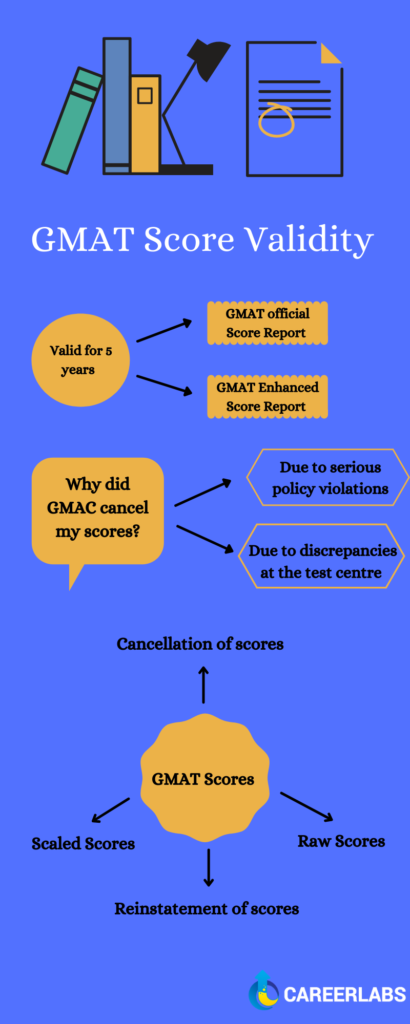
The GMAT score is your ticket into top business institutions across the globe, but these scores are valid for only a certain period. Are you wondering how long your GMAT score is valid? The GMAT score is valid for 5 years from the date of your examination. For instance, if you have given the exam in October 2023, then your scores will be valid until October 2028. The GMAT scores can be used while applying to universities, jobs and even internships.
While the score validity lasts only up to five years, you can continue to list these scores on any application if you feel it adds significant value. You can continue to do this for up to ten years. However, after ten years, the GMAT scores cannot be listed on applications and become insignificant. All in all, the GMAT validity for MBA applications is 5 years beyond which you may have to present fresh GMAT scores.
Raw Scores versus Scaled Scores
Are you wondering how the GMAT score varies by a large margin from the total GMAT score? We will help you understand how the GMAC calculates GMAT scores. There are two kinds of GMAT scores— raw scores and scaled scores. The raw scores are calculated based on the number of questions you have answered correctly. For example, if you have answered 7 out of 8 questions correctly in the Integrated Reasoning section, then your raw score will be 7. The scaled scores refer to a score range for each of the GMAT sections. For example, the Verbal Reasoning section is scored between 6 to 51, which means your score may lie anywhere between this score range.
The GMAT is a computer adaptive test, this means that as you attempt each section and progress to the next, the difficulty level of each section increases invariably. The varying difficulty levels play a significant role in converting raw scores to scaled scores. The raw scores are converted to scaled scores based on an algorithm that calculates the number of questions attempted, the number of questions answered correctly and based on the difficulty level of the question answered.
How is Each Section of the GMAT Scored?
Each of the GMAT sections is calculated in a specific manner. We will explore how each of the sections is scored. in the following section.
Analytical Writing Assessment (AWA)
The AWA consists of an essay that is scored by a qualified human scorer and by a machine algorithm. The GMAT AWA section is scored between 0 to 6. A score of 6 is given to exceptionally drafted essays, which is quite rare but not unattainable. A score of 0 is given to these essays which are completely irrelevant and are poorly drafted. The GMAC has studied these methods of scoring and has concluded that the machine algorithm and the human scorer’s manner of scoring vary by a very small margin. However, in cases where the scores between the two differ by a whole point or a point and a half, a second reader is brought in.
Integrated Reasoning(IR)
The Integrated Reasoning section is not an adaptive section. This means the manner in which the score is calculated, is based on the number of questions attempted and the number of correct answers.
Quantitative Reasoning (QR) and Verbal Reasoning (VR)
The QR and VR sections are each scored based on the number of questions answered, the number of right answers, and the difficulty level of each of the questions answered. The GMAC uses an intricate algorithm to score these sections based on the varying difficulty level which has not been disclosed publicly to date.
What is a Good GMAT Score?
A good GMAT score helps you get into the business school of your choice. Let’s take a look at what is considered a good GMAT score. The table below lists the scores and corresponding rating for each score:
| Scores | Rating |
| 740+ | Excellent |
| 700 to 740 | Good |
| 550 to 700 | Average |
| Below 550 | Poor |
However, what may be considered a good score varies from one business school to another. Hence, the definition of a good GMAT score varies from person to person. A good score is also defined by the cutoff set by your preferred university or business school. For instance, if you secure a score of 680 and it is accepted by your preferred business school, then that is a good score for you. However, do keep in mind that your GMAT score is valid for only five years, which means you cannot use these scores beyond five years even if they are excellent.
What is Percentile Ranking in GMAT?
The GMAT score report lists a percentile ranking that corresponds to your scores. The ranking indicates the percentage of candidates that have scored less than you. For instance, if your percentile ranking is 75 percent, then this means that 75 percent of the candidates who have taken the test have scored less than you. However, it is important to note that your percentile ranking can vary by a small difference, as each academic year the rankings are updated and modified based on the number of test-takers each year and based on the rankings available from the previous three years. While your percentile ranking might increase or decrease by a very small margin, the score validity period of five years remains unchanged.
Is your GMAT Score Valid in India?
Many of the top Indian business schools accept valid GMAT scores. We have created a table with the Indian b-schools accepting GMAT scores, the programs offered by them, and their GMAT cut off. The table is as follows:
| Management Institute | Programs | GMAT cutoff |
| XLRI, Jamshedpur | General MBA | 700+ |
| Indian Institute Of Management, Calcutta | PGPEX | 700+ |
| Indian Institute Of Management, Ahmedabad | PGPX | 700+ |
| Indian School Of Business (ISB), Hyderabad | PGP, YLP | 700+ |
| Indian Institute Of Management, Bangalore | EPGP | 690+ |
| IMT, Ghaziabad | PGDM, PGDM-Ex | 690+ |
| SP Jain Institute Of Management & Research | PGDM | 680+ |
| Great Lakes Institute Of Management | PGDM | 680+ |
| Indian Institute Of Management, Lucknow | IMPX | 680+ |
| Indian Institute Of Management, Indore | EPGP | 580+ |
GMAT Score Report
The GMAT score report is your official score report, which is available to you three weeks from the date of your examination. The score report includes the scores of each of the GMAT sections with the corresponding percentile rank for each of the scores. The GMAT score report also has the personal information that you had filled in during the registration process. This includes your number, address, previous academic qualifications, corresponding grades, and a digital photograph of you taken at the test centre.
Enhanced Score Report
The score report can be rather confusing to decipher. This is where the enhanced score report comes in. The enhanced score report helps you decipher your score report by breaking down each section and providing you with an extensive analysis of your performance in the same. The aim of the GMAT enhanced score report is to educate you on how you have fared in the exam and how that will consequently impact your business school applications. It gives you a detailed insight into how you have performed with respect to various factors.
The various factors here refer to the difficulty level of the question, the section it belongs to, the question type and the pace at which you’ve attempted the exam. While the enhanced score report gives an insight into your performance, it is important to note that it is not your official score report. It is based on your GMAT unofficial scores. Since it is based on your unofficial scores, the enhanced score report is available to you after 24 hours of giving your GMAT. However, you have to make a payment of $30 to receive the report. The validity of the enhanced score report is 5 years as well.
Cancellation of GMAT Scores
Your unofficial GMAT scores are available to you immediately after you’ve completed your GMAT exam. At this point, you can either choose to accept or reject your unofficial scores. It is highly recommended that you have a target score in mind, as you will have only two minutes to accept the unofficial scores. If you do not accept these scores within two minutes, your GMAT unofficial scores will be cancelled. Once the scores are cancelled, they will not be sent to the universities that you’ve listed.
Additionally, you will not receive your unofficial score report at the test centre and your official score report will be withheld. You will also have to wait another 16 days to retake the GMAT exam. However, if you’ve accepted your unofficial scores at the test centre and wish to cancel them at a later point, you can do so within 72 hours. But you will be charged an additional fee to cancel the scores once you leave the test centre.
Reinstatement of GMAT Scores
If you want to reinstate your GMAT scores after having cancelled them, you can do so. However, you will be charged a fee to reinstate your GMAT scores. You can reinstate your GMAT scores within 4 years and 11 months from the date of your examination. This period is calculated keeping in mind the score validity limit, which is 5 years. The reinstatement of the GMAT scores ensures that the universities listed by you, receive your GMAT scores. However, if you wish to add universities to this list, you will not be allowed to do so. In such a case, you can purchase additional score reports. This will cost you around $35 per score report.
Why Did GMAC Cancel My GMAT Scores?

The GMAC has the authority to withhold or cancel your scores at any given point in time. This is done to ensure that a fair opportunity is provided to each of their candidates. The GMAC can withhold or cancel scores if there is a violation of policy, some kind of a testing issue or if your scores are invalid due to other factors.
How am I to find out if the GMAC cancels my score?
If the GMAC cancels your scores, it is indicated by a reason code. The reason code is a signifier, usually an alphabet to indicate what error has been committed by you. Here is how to decipher the reason codes that you might find in your score report if the GMAC has cancelled your scores.
Testing Issues: “T”
When your score report shows the reason code “T”, it means scores have been cancelled due to testing issues. These testing issues refer to any error or irregularity in the administration of the test. This means you amongst many other candidates face this error. The testing errors refer to administrative issues, discrepancies at test centres, payment issues, registration errors, and exposure of contents of the exam. However, cancellation of scores can happen even in cases where you have not directly violated the test policies.
In such cases, you are offered two choices — the first being you can appear for the exam at absolutely no cost and the second wherein, the exam fee is refunded back to you. However, in an instance where you have engaged in a violation of conduct, one which is not a grave concern and has happened due to misinformation or negligence. You might be offered a chance to rectify the error or undergo corrective action.
Common Policy Violations: “P”
If the score report shows the reason code “P”, it means the scores have been cancelled due to common policy violations. Some of the common policy violations include accessing study material during the exam, possession of any kind of electronic device in the examination hall, and possession of any unauthorised material. There are dire consequences if you do violate these policies. It will lead to you being banned from taking the test for three years, your score is reversed, and subsequently, the universities you’ve listed will be notified.
Serious Policy Violations: “S”
When your score report shows the reason code “S”, it means the scores have been withheld due to serious policy violations. Some of these policy violations include revealing test content, fraud or fraudulent behaviour, identity theft, creating a ruckus at the test centre, and any form of violence that is strictly prohibited. Violating any of these policy measures will lead to the revocation of your GMAT scores. A notification will also be sent to all the schools you have listed and you will be banned from participating in the exam for the next 3 years to an indefinite period or even your entire lifetime.
The duration of the ban depends on the severity of the violation. However, if you feel the scores are cancelled due to unfair reasoning, you can appeal to the GMAC a month after you’ve received the score report. The appeal is to be made to the GMAT customer service either by phone or through email. It is important to note that you need to submit all the relevant supporting documents for the appeal. Upon reviewing the documents, the GMAC uses its discretion to come to a conclusion. The GMAC will then offer you a couple of options, which is either taking the test free of cost or following up on the decision of cancellation with due procedure.
Do Business Schools Have Access to All Your GMAT Scores?
The official GMAT score report lists all your GMAT scores, including those from your GMAT exam retakes. Nevertheless, if you cancel the GMAT score at the test center, the cancelled score will not appear on your official score report. So, rest assured the listed universities or business schools do not have access to all your GMAT scores. However, some universities and business schools require you to send in all your GMAT scores so you can track your progress with each of the exams you have taken. In such a case, you will be required to submit all your exam scores.
Does the GMAT Score Look Good on Your CV?

The Curriculum Vitae (CV) is an important document that is required by most companies or organisations if you are applying to work with them. A CV lists all your academic qualifications and achievements, internships, and work experience if any. In addition, if you have work experience in the relevant field, the CV discusses the impact you created and the responsibilities you’ve taken up in the organizations you have previously worked for. With competition on the rise, hunting for a job can get very overwhelming.
The pressure of being exceptional amongst many others applying for the same job can weigh heavily on you. But if you have completed an MBA degree, this already sets you apart from the other candidates. This is where the GMAT scores come into the picture. Since the GMAT is specifically designed for management admissions, a good GMAT score means you possess relevant managerial knowledge and skills. Hence, having a good GMAT score adds significant value to your CV and can make your CV look great.
How to Achieve the Perfect GMAT (700+) Score?
A good GMAT score is most likely to increase your chances of getting into the business school of your choice. To achieve a good GMAT score, you must come up with an efficient study plan. Before you begin planning, it is important to set a target score for yourself. This will help in drafting a productive study plan with an achievable goal in mind. Proper planning and consistent practice will get you the perfect GMAT score. We hope now you are well acquainted with everything to do with your GMAT scores and the GMAT score validity and have no doubts regarding the same. In addition, we have also informed you of the various policy violations and their consequences. So, what are you waiting for? Prepare well and ace the GMAT exam!
FAQs
Q: Do GMAT scores expire?
Yes, GMAT scores expire once the score validity expires.
Q: How long is my GMAT score valid?
The GMAT score validity lasts for five years.
Q: I exceeded the time limit to accept my GMAT unofficial scores at the test centre, what can I do to reinstate my scores?
If you have exceeded the time limit to accept your GMAT unofficial scores at the test centre, they are likely to be cancelled. However, you can reinstate these scores within 4 years and 11 months from the date of the exam. But you can only do so by paying an amount of $50.
Q: When will I receive my official score report?
Your GMAT official score report will arrive three weeks from the date of your examination.
Q: Can I get my enhanced score report despite having cancelled my GMAT scores?
Yes, you will receive your enhanced score report even if you have cancelled your GMAT scores. However, if your GMAT scores are cancelled by the GMAC due to policy violations, then you will not receive the enhanced score report.
Q: Can I cancel my scores after having accepted them at the test centre?
The scores can be cancelled within 72 hours from the time of your exam, even after you have accepted them at the test centre. However, once you leave the test centre, cancelling the scores comes at a cost. You have to pay $25 to cancel your GMAT scores.









Talk to an expert?