
 All Courses
If you are an MBA aspirant, a good GMAT score is imperative for increasing your chances of admission into the business school of your choice. However, acing the GMAT exam with a high score requires you to consistently practice sample questions. For this, GMAT exam sample papers are probably the best resource, as it familiarizes you with the type of questions asked in the exam.
Solving these GMAT exam papers acquaints you with the GMAT exam pattern and syllabus. This also helps you analyze your strengths and weaknesses, thus, giving you an overview of how much you’re prepared.
This article will shed some light on the structure of the GMAT sample test paper, some sample questions and tips to help you prepare for the GMAT exam.
GMAT Quantitative Reasoning sample questions and answers
GMAT Verbal Reasoning sample questions and answers
Structure of GMAT Exam Sample Paper 2023
The GMAT Exam paper consists of four sections — Quantitative Reasoning (QR), Integrated Reasoning (IR), Verbal Reasoning (VR), and Analytical Writing Assessment (AWA). The paper has both objective and subjective questions, and you’ll have 3 hours 30 minutes to complete the exam, including two optional 8-minutes breaks.
Let’s have a detailed look at the sections that are included in the GMAT exam.
- Quantitative Reasoning
Quantitative Reasoning consists of two types of questions — Problem Solving and Data Sufficiency. To solve these questions you need to have knowledge of arithmetic, algebra and geometry. However, you are required to not only use your mathematical skills but also your logical and analytical reasoning skills to interpret the given data and solve questions. This section measures your ability to logically and analytically solve quantitative problems.
No: of Questions asked – 31
Time Duration – 62 minutes
Score Range- 6-51 (in 1-point increments)
- Integrated Reasoning
The Integrated Reasoning section consists of four question types — Graphics Interpretation, Multi-Source Reasoning, Table Analysis, and Two-Part Analysis. These questions are designed to measure your ability to examine data and integrate the information given in multiple formats (such as graphs, charts and tables) to solve complex problems. Hence, answering these questions requires critical thinking and logical reasoning skills.
No: of Questions asked – 12
Time Duration – 30 minutes
Score Range- 1-8
(in 1-point increments)
- Verbal Reasoning
In GMAT Verbal reasoning, you are asked to answer questions from three different sections — Reading Comprehension, Critical Reasoning, and Sentence Correction. The questions test how well you can read, comprehend and critically analyze a given argument in standard written English. You need to use your English language skills along with your critical reasoning skills to answer the questions. However, you will not need any subject matter expertise to answer these questions, as this section mainly tests your command of the English language.
No: of Questions asked – 36
Time Duration – 65 minutes
Score Range- 6-51 (in 1-point increments)
- Analytical Writing Assessment
The Analytical Writing Assessment section consists of a writing task — in English — wherein you have to analyse and critique an argument. The topic of the argument can be related to anything — business or general. Having said this, you need not have any specific knowledge of the topic because you are essentially tested on your ability to process, break down complex information, critically analyse a given topic and articulate your thoughts with clarity and cohesion.
No: of Questions asked – 1
Time Duration – 30 minutes
Score Range- 0-6
(in 0.5-point increments)
GMAT Exam Sample Question Papers with Solutions
Solving GMAT sample papers is one of the most reliable methods of assessing your performance. Once you start your preparation for the GMAT exam, it is essential to be consistent, and check your progress on the go. Practising these GMAT exam sample papers with solutions helps you identify your weaker areas and understand which section needs more preparation. It also stimulates the actual GMAT exam experience and familiarises you with the question pattern, marks distribution, etc. Most importantly, consistent practice helps reduce your stress and exam fear.
The internet is flooded with websites that offer you practice questions or GMAT exam sample paper PDFs that will help with your preparation. However, you need to be careful while choosing the source of your GMAT sample paper pdf. We recommend you to rely on official sources like mba.com (the official website of GMAC). The website provides two free sample papers online upon registration and a mini GMAT Quiz. Also, if you want to access more resources like official practice questions or GMAT Official Guide Bundle 2022, you will have to buy them from the website.
To begin with, here are two sample GMAT questions to help you understand the question pattern.
Quantitative Reasoning
Q. In a circus company, the price of tickets for adults and children were $50 and $30 respectively. The company has sold a total of 1000 tickets. The average (arithmetic mean) price per ticket sold was $42. How many tickets were sold for children?
A)200
B) 300
C) 400
D) 600
E) 800
Answer: C
Verbal Reasoning
Q: The design of the neck muscles and the spinal bones of the mollusks allow that it can pull in the exposed parts of the body such that the predator doesn’t find anything but a hard shell to bite.
A) allow that it can pull in the exposed parts of the body such that
B) allow it to pull in its exposed parts, and so
C) allows that it can draw in its exposed parts, and so
D) allows for it to draw in its exposed part, and that
E) allows it to draw in its exposed parts, so that
Answer: B
Benefits of Solving Sample Question Papers
Solving the GMAT sample question papers helps you in several ways. A few of them are as follows:
- Familiarizes you with the question pattern – GMAT sample papers simulate the actual exam conditions. Hence, solving these papers acquaints you with the section-wise timing, question pattern and the concepts tested in the exam. Additionally, you can practice for the exam by having a look at previous year question papers such as GMAT sample paper 2022 or 2021 and more. This is a good way to prepare for the GMAT exam. You can also look for some GMAT test sample PDFs online. There are numerous practice test PDFs available online, however, make sure you choose the ones that are credible.
- Helps you assess your weaknesses – Solving sample GMAT papers help you identify your stronger and weaker subject areas. Having a clear understanding of what topics you are confident about and what topics you need to work hard on helps you keep track of your progress during your exam preparation.
- Boosts Confidence – Solving sample papers help in boosting your confidence. The more papers you solve, the more you understand the pattern, question types, your weaker subject areas etc. This will help you take your preparation in the right direction. Since most GMAT sample papers replicate the actual GMAT exam paper, solving them will help boost our confidence. You can also look for GMAT previous year question paper PDFs online and practice as much as you can. This helps you get an idea of how the actual exam is conducted. Attempting questions from previous year GMAT papers will also help boost your confidence.
- Helps you learn time management strategies – One of the significant benefits of solving sample papers is that you learn strategies to manage time efficiently. Time management is essential to ace the competitive exams with a stellar score, especially the GMAT exam. As mentioned earlier, sample papers acquaint you with the pattern of the test, thus providing you with an idea of how much time you should spend on each question. This will help you manage your time wisely on the actual test day.
Tips to Solve GMAT Sample Test Papers
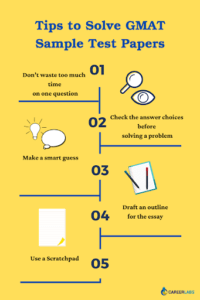
You aren’t expected to get every question right in a competitive exam like GMAT. However, with a proper strategy, a smart study plan, consistent practice and the right resources, you can increase your speed and scores.
Given below are some useful tips to solve GMAT sample question papers.
- Don’t waste too much time on one question
When you take the test, ensure you answer all questions. Not doing so leads to a double penalty, and all your effort may go in vain. Hence, it is essential you keep a track of time when attempting all the questions asked in each section. For this, it is best to come up with strategies when preparing for the exam. You can allot a certain time for each section and question. However, if at any point in the exam you are stuck with a question, do not waste time. You can use the elimination technique in such situations and answer a question. In case you are still confused, move on to the next. It’s very important to stick to the timing you planned for all questions during the preparation test. Failing to do so will not deliver favourable results and lead to a bad overall GMAT score.
- Check the answer choices before solving a problem
While solving tricky mathematical problems, go through the answer choices before starting the calculations. Sometimes, answers are also part of a question. Hence, information from the answer choices could help you solve the question. For example: If you are asked to find the multiples of 5 from a given set of 6-digit numbers, you can look at the answers and eliminate the options that don’t have 5 or 0 in their unit digit. This technique helps you save time and effort by eliminating illogical choices.
- Make a smart guess
As we mentioned earlier, you must not spend too much time on one question during the exam. However, if you are caught up in such situations, it is imperative to make logical guesses and move to the next question. Using the elimination technique is the best way to improve your chances of getting the correct answer while guessing. For this, you must eliminate the answer choices that have no logical connection with the question. Once you remove the incorrect answers, make a calculated guess, select an option and move to the next question. Try as much as you can to guess an answer as leaving one question unanswered could affect your marks, as the scores are based on the number of questions answered.
- Draft an outline for the essay
The Analytical Writing Assessment section of the exam can be time-consuming as it involves a lot of critical thinking and writing. Hence, it is advisable to draft an outline of your essay before you start writing. Make notes as you read the question and pen down your thoughts in bullet points. You can refer to all these points that you have jotted down, as you start typing the answer later. This method ensures you’ve added all the relevant points in your answer.
- Use a Scratchpad
When you attend the GMAT offline exam, you’ll be given a scratchpad (five sheets of laminated grid paper) and a marker to take notes during the exam. Use the scratchpad wisely to note down all relevant points as you read the questions (such as details from Reading Comprehension or Quant figures). This would act as a reference to answer the questions. However, make sure to divide the sheet wisely based on the calculations/notes needed for each section, as you cannot erase anything once written on the sheet.
Solving GMAT sample papers improves your chance of getting a high score in the exam. Moreover, a consistent practice not only builds your confidence but also enhances your skill sets. However, make sure you pick only the best and credible GMAT sample papers that will help you know where you stand when you prepare for the exam. Once you have practised enough and are confident about your GMAT exam prep, put your knowledge to the test. Good luck!
FAQs
- Where can one download GMAT sample papers?
There are many options from which you can choose to download GMAT sample papers. However please ensure that they are from reliable sources like the official GMAT website (Mba.com).
- Will the GMAT sample papers also have solutions mentioned?
Most of the GMAT sample papers available online are solved papers and hence you will be able to understand how to solve the questions with ease. You can also increase your accuracy of answering questions by solving sample papers.
- Is the question pattern of the sample papers the same as that of the GMAT?
Yes, the pattern of questions asked in the GMAT and the sample papers are similar. Hence you get accustomed to the structure of the GMAT exam.









Talk to an expert?